Supercharging utility inspection operations with AI image analysis; pricing and benefits.
Insights from a pilot project with the goal of inspecting 800.000 poles yearly, powered by a new AI image analysis algorithm.

Insights from a pilot project with the goal of inspecting 800.000 poles yearly, powered by a new AI image analysis algorithm.
In 2025, AI image analysis is no longer an emerging concept — it’s a practical tool transforming how utilities handle inspections at scale.
At Scopito, we’ve been at the forefront of this shift — not with one-size-fits-all algorithms, but with customer-specific AI tuned to each client’s assets, workflows, and risk priorities.
That specificity matters. It’s why we can’t simply publish a generic “AI benefits” list — because the real gains depend entirely on your data, your assets, and your operational goals.
This case study on AI image analysis offers a grounded look at what’s possible. It’s based on a large-scale pilot project with a major South American utility aiming to inspect 800,000 poles annually. By pairing targeted AI image analysis with Scopito’s platform, the utility has turned an overwhelming manual task into a fast, accurate, and repeatable process.
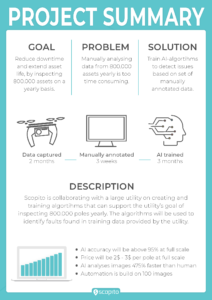
In 2025, the utility’s goal remains clear: reduce downtime and extend asset life by inspecting 800,000 of their 5–6 million poles and towers annually. This coverage would allow them to detect issues early, prioritize repairs, and make data-driven maintenance decisions that protect both reliability and asset value.
Like most large-scale AI inspection initiatives, this project began with a six-month pilot to prepare for full-scale rollout.
For this pilot, Scopito developed algorithms using images representing just 0.04% of the utility’s total assets. Fault types targeted include:
The exact areas of interest depend on the faults uncovered during the manual annotation phase.
At full scale, the cost is under $5 per pole — covering storage, processing, AI analysis, and visual presentation.”
By integrating AI image analysis, the utility can scale inspections year after year while extending asset lifespans. At the same time, they’re building a detailed digital twin of their entire network—an asset for both today’s maintenance planning and tomorrow’s predictive strategies.
Speed is what makes large-scale AI inspections possible. Manually analyzing images of 800,000 structures simply isn’t realistic.
In 2025, Scopito’s AI image analysis processes 1,000+ images per hour, compared to about 175 images per hour for a skilled human analyst. With an average of two images per structure, that’s 1.6 million images per year.
For a human team working around the clock, analysis would take 380 days.
In comparison, it would take Scopito AI 66 days—and its processing capacity can scale further without significant added cost.
This speed advantage not only shortens inspection cycles but also accelerates the time from fault detection to repair, directly reducing outage risk and maintenance backlogs.
*AI processing capacity can be scaled up quickly to handle larger workloads without driving up costs.
Speed is only half the advantage—AI image analysis delivers consistency that human teams simply can’t match. It doesn’t get tired, distracted, or influenced by external factors.
With high-quality, well-labeled training data, accuracy quickly surpasses 90%, and as more data flows through the system, it continues to improve. In this project, accuracy is expected to exceed 95% once operations reach full scale—delivering reliable fault detection across millions of assets.
Faster, more reliable inspections mean issues are caught earlier—often before they lead to costly failures. That gives maintenance teams the head start they need to fix problems while they’re still minor.
Over time, as the AI processes more inspection data, it can identify patterns that signal emerging risks. This predictive maintenance capability allows utilities to prioritize repairs, plan budgets more effectively, and extend the operational life of their assets.
Impact: Early detection and predictive maintenance can extend asset life by 20–30%, reducing long-term replacement costs by millions.
Not all AI image analysis delivers the same value — the real impact comes when it’s paired with a visualization platform like Scopito.
For utilities managing millions of assets, visualization isn’t a “nice to have” — it’s the only way to maintain control at scale. Without it, the data from AI inspections quickly becomes overwhelming. The more faults you detect, the harder it is to prioritize and act.
Scopito solves this by delivering clear, intuitive overviews at every level:
By turning massive datasets into logical, actionable views, we make AI insights usable. Without that, AI is just numbers — with it, AI becomes a decision-making tool.
Impact: Utilities using Scopito’s visualization tools report inspection-to-action time reduced by up to 40%.
Your Quick-Reference Version
Want the key takeaways in a format you can save or share?
We’ve turned this case into a concise, 3-page PDF that’s perfect for:
Do you have a project that could benefit from AI image analysis?
Let’s talk about how Scopito can help you shorten inspection cycles, reduce costs, and keep assets performing at their best.
Contact Us →
Original article by Ditte R. Lønstrup. Updated in 2025 by: Gayle Godkin, Scopito’s Marketing Representative, who specializes in the commercial drone inspection space and helps communicate the value of visual inspection data to infrastructure industries.
Enter your details below to continue
I have read the Terms of Use and declare that I agree
Please send me occasional e-mails about the product.

14 Days free trial starts automatically when you sign up