AI Today
#2 in our series on Artificial Intelligence in the visual infrastructure-inspection industry.

#2 in our series on Artificial Intelligence in the visual infrastructure-inspection industry.
In 2025, AI in visual inspections is considered a standard part of inspection workflows across utilities, powerlines, and renewable energy assets.
Today’s AI systems reliably handle object detection and fault detection tasks, accelerating human review rather than replacing inspectors. The key factor is data quality: models trained on a utility’s own inspection history provide the most accurate, trustworthy results. Looking into 2026, full automation may be within reach, but even now AI consistently reduces costs, speeds up analysis, and helps organizations turn inspection data into long-term strategic value.
AI is now embedded in inspection workflows across utilities, powerlines, and renewable energy assets. What was once seen as futuristic is now an expected standard: computer vision models flag anomalies, and inspectors verify and act on them.
In the past 5-10 years, “AI and Machine Learning” were the hot buzzwords in visual data management. But now, the conversation has shifted. Today’s AI in visual inspections is about proven systems that reliably support inspectors with fault detection, object recognition, and data tagging.
And the fear that AI will replace experts is fading, replaced with the real-world knowledge that AI accelerates their work. Tasks like identifying rust, cracks, vegetation encroachment, or hardware issues are surfaced by algorithms so human reviewers can focus on decisions, not data-sifting.
Despite the clear benefits, AI in visual inspections is not yet fully autonomous. The progress is real, but several obstacles remain before algorithms can match — or replace — the judgment of experienced inspectors.
1. The limits of computer vision.
We are still asking algorithms to “understand” images based on an incomplete understanding of how human vision works. Machines can detect statistical patterns at scale, but they don’t “see” context the way humans do. This gap makes full replacement of human expertise unrealistic — at least for now.
2. Data quality and labeling.
AI models are only as strong as the inspection data used to train them. Utilities often sit on massive archives of images, but much of it is unlabeled, inconsistent, or scattered across silos. Without structured, well-annotated data, even the most advanced models will underperform.
3. Human variability in training.
Ironically, human input is still required to train and refine AI models. Different inspectors may label corrosion, cracks, or vegetation in slightly different ways, which creates inconsistencies that ripple through the algorithm’s accuracy. Standardizing this process is still a challenge across the industry.
The result? AI in inspections today is best seen as a refine-as-you-go tool — extremely effective for surfacing faults, accelerating workflows, and reducing risks, but still dependent on quality data, careful oversight, and ongoing calibration.
Neural networks (NNs) need enormous amounts of high-quality data to deliver accurate, trustworthy results. And while the inspection industry generates millions of images every year, the reality is that much of this data is scattered, inconsistently labeled, or never structured for training at all.
This creates the central paradox: the data exists, but only a fraction is usable for AI. Utilities and DSPs often find that their archives are full of images but short on the consistency needed to build reliable models.
The good news is progress is happening fast. Platforms like Scopito make it easier to store, structure, and label inspection data in ways that directly improve model training. In practice, that means algorithms for specific use cases — such as corrosion on transmission towers, vegetation encroachment near lines, blade erosion on wind turbines, or soiling on solar panels — are already performing at a very high level today.
But the takeaway is clear: AI in visual inspections succeed because of the data behind it. Without high-quality, well-labeled inspection history, even the best neural networks fall short.
That leads us to the next problem.
Even as algorithms improve, one obstacle remains: humans. With so many organizations building their own AI models, it’s difficult to make them universally applicable.
Machine learning depends on labeled data and corrective feedback. But when annotations aren’t standardized, the model’s accuracy suffers. Two engineers could both be training an algorithm to detect corrosion on transmission poles — yet subtle differences in labeling lead to inconsistent results. The same is true for blade damage on turbines or hotspot detection on solar arrays.
Platforms like Scopito address this by allowing each utility or service provider to adapt algorithms to their own standards. Because the baseline models are already trained, just a small set of annotated images — sometimes as few as 15 — can be enough to fine-tune performance to the specific needs of a grid operator, solar farm, or wind project.
Despite these challenges, the industry has come a long way in just a few years. But with so many vendors competing — and marketing language outpacing real-world capability — transparency can be hard to come by. Which raises the critical question: how far have we really come?
“AI brings to the table the magic of human decision paths – they’re very complex, and unmatched by regular machine vision systems.”
– Massimiliano Versace (Jim Vinoski, 2020)
In 2025, many of the tools that once sounded experimental are now widely available. Open-source platforms like Keras, part of TensorFlow by Google’s ecosystem, Torch and Scikit-learn provide the foundation for many in-house algorithms, while commercial ecosystems like IBM Watson and Amazon SageMaker Neo make enterprise-level deployments possible.
Other companies are creating their algorithms from scratch, and some in turn, allow users to integrate their own AI as well.
The reality, however, is that no single algorithm can solve every problem. AI in visual inspections is highly task-specific: it excels where models are trained on strong, relevant datasets. That’s why organizations are urged to demand live proof of working AI before committing — especially when inspection quality directly impacts grid reliability or renewable generation uptime.
There is no algorithm that can complete every task, and no one has perfected all their AI-capabilities yet.
So what’s truly possible today? In utilities, solar, and wind turbine inspections, the most effective AI applications fall into two categories:
Object detection – Identifying and classifying anomalies across large sets of inspection images. For example, corrosion on transmission towers, hotspots on solar panels, or blade edge erosion in turbines. AI makes these datasets searchable and actionable in minutes.
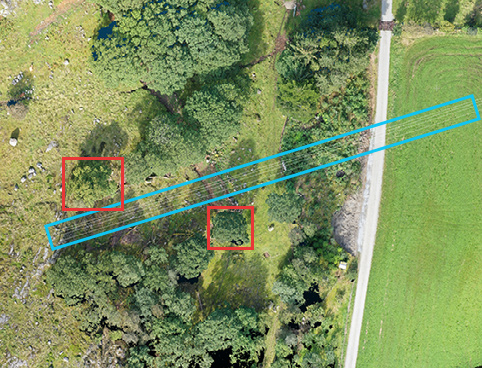
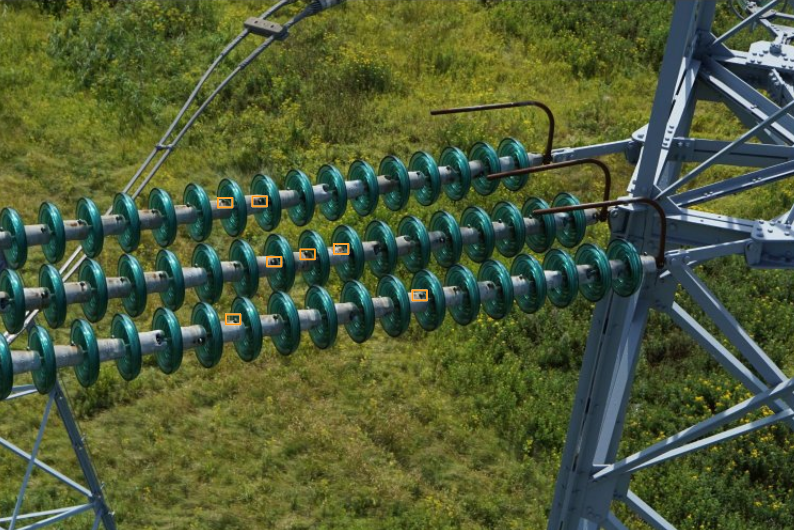
Instance segmentation – Going a step deeper, AI now highlights exact pixel-level boundaries of defects. This is especially powerful for vegetation management near powerlines or for mapping the spread of cracks across turbine blades.
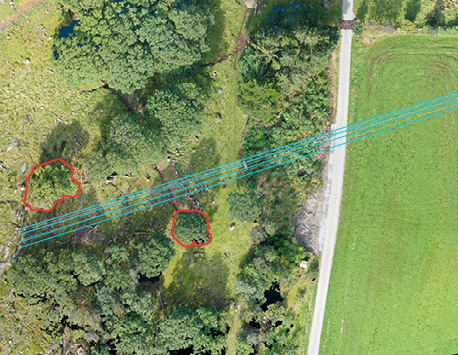
These are not prototypes anymore — they’re deployed capabilities delivering daily value. The challenge isn’t whether AI works, but how well it’s trained, how transparent the results are, and how consistently those results can be integrated into inspection workflows.
Other common uses of computer vision in the visual inspection industry now include 3D modeling, asset visualization, and digital twin development. These capabilities allow utilities and renewable operators to see assets not just as static points-in-time, but as evolving digital records.
In 2025, AI in visual inspections can:
The current applications are powerful — and still represent only a fraction of what’s possible. Every dataset captured today contributes to better models tomorrow, paving the way for predictive maintenance at scale.
The use cases for AI in industrial inspections are virtually endless, but the direction is clear: from reactive inspection to proactive asset management.
👉 In the next article of this series, we’ll explore AI Tomorrow — what’s still emerging, what’s experimental, and where the greatest opportunities lie for the future of infrastructure inspections.
What do you think?

Original article by Ditte R. Lønstrup. Updated in 2025 by: Gayle Godkin, Scopito’s Marketing Representative, who specializes in the commercial drone inspection space and helps communicate the value of visual inspection data to infrastructure industries.
Enter your details below to continue
I have read the Terms of Use and declare that I agree
Please send me occasional e-mails about the product.

14 Days free trial starts automatically when you sign up

